Satellite Signal Lost in Rain? Causes and Lasting Fixes
·7 min read
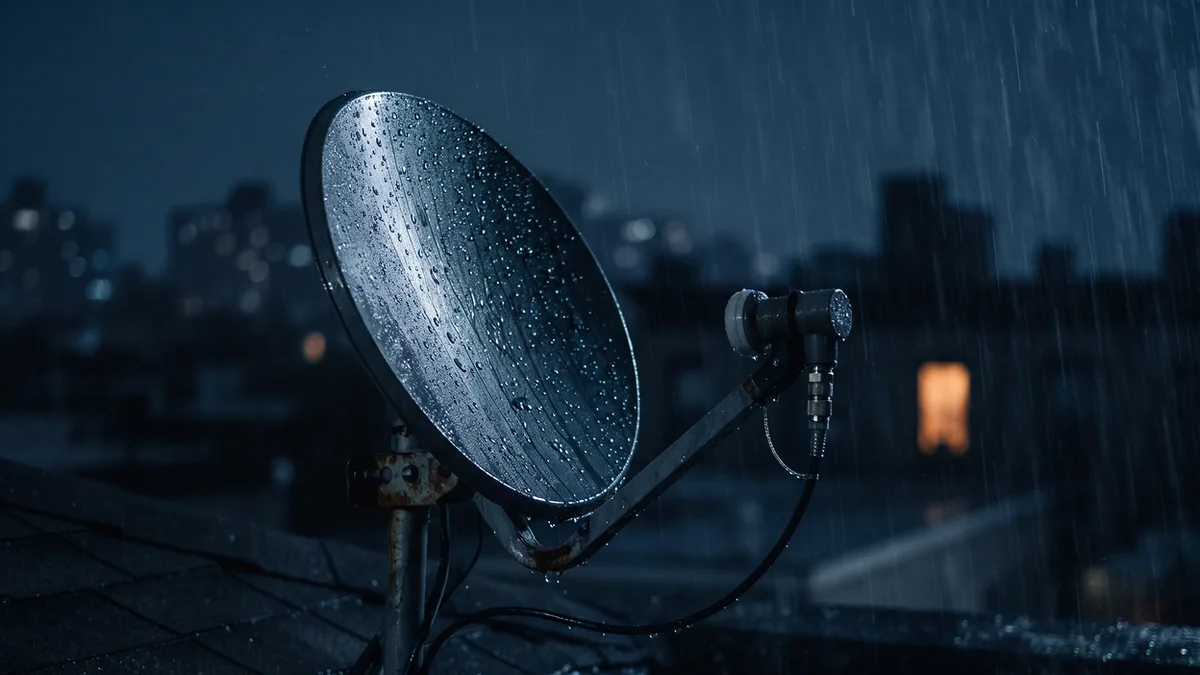
If your satellite signal is lost in rain, there are two possibilities: heavy rain is genuinely weakening the signal (rain fade), or your system had no margin left and the rain is simply the last straw. The first is brief and clears when the downpour passes; the second repeats in every cloudy spell, and the fix is in the dish, alignment, LNB or cable. The order below usually solves it at the dish itself.
Why rain cuts the signal
TV broadcasts from satellites such as Astra, Hot Bird or Türksat arrive in the Ku band, between 10.7 and 12.75 GHz. At these frequencies raindrops absorb and scatter the signal; when a dense shower cell passes between satellite and dish, the signal can drop below the receiver's threshold for a few minutes. Wet snow, and snow building up inside the dish, make it worse.
Margin is what counts: the higher the signal quality in clear weather, the more room there is to lose in rain. If the quality reading is already borderline on a dry day, even light rain will cut the picture.
Measure first: quality, not strength
In the receiver's menu (usually under settings or installation, or by pressing the info button twice on a channel) you'll see two bars: signal strength (level) and signal quality (quality, SNR or C/N). Quality is the one to watch. High strength with low quality points to alignment or interference; both low points to dish, LNB or cable.
Write down the quality reading on a clear day. When the picture drops in rain, check the same channel again: knowing how far it falls is the only way to tell weather from a fault.
Five checks, cheapest first
- 01Check in front of and inside the dishA branch growing into the line of sight, new scaffolding, or snow and leaves in the dish eat into the signal before rain does. Wet leaves attenuate far more than dry ones, which is why problems often start in late summer.
- 02Open and inspect the connectorsUnscrew the F connector under the LNB. Water, green oxide or blackened copper inside is very likely why the picture fails in rain. Cut it off, fit a new one, preferably a compression type, and cover it with a rubber boot or self-amalgamating tape.
- 03Follow the cableCable crushed in a window frame, with a sun-cracked jacket, or lying in water on the balcony draws in moisture and loses signal. Replacing old, thin cable with good double-shielded coax is a cheap and effective upgrade.
- 04Fine-tune the alignmentWind and temperature swings shift a dish by millimetres over time. On a clear day, watching the receiver's quality reading, move the dish in very small steps horizontally and vertically, waiting a few seconds after each. Try rotating the LNB in its holder (skew) too. Aim for the highest quality value, not just "picture is back".
- 05Replace the LNBIf quality is lower than on other satellites or neighbours' dishes even with good alignment, the LNB may be ageing. It's a relatively cheap part; recheck alignment after swapping it.
Don't forget the connections indoors
The fault isn't always on the roof. If the cable from the dish runs into a multiswitch, a splitter or a wall socket, every joint costs a little signal, and those small losses can eat the margin that keeps the picture on in rain. Check for loose, finger-tight F connectors, try connecting the dish cable straight to the receiver to see whether quality rises, and if several satellites are combined through a DiSEqC switch and only one drops in rain, look at the switch first.
Is the dish big enough?
The dish size you need depends on where you sit in the satellite's footprint, and operators publish coverage maps. At the edge of a footprint — receiving Türksat in the UK, for example — a dish that looks fine in clear weather may leave no margin for rain. A larger dish collects more signal, and that difference shows exactly when it rains.
| Symptom | Likely cause | Fix |
|---|---|---|
| A few minutes' loss only in downpours | Rain fade, little margin | Fine alignment, larger dish if needed |
| Hours of loss in every rain | Water in the connector | Replace and seal the connector |
| Some channels go, others stay | Weaker transponders drop first | Check alignment and LNB |
| No signal at all after a storm | Dish has moved | Realign, tighten the mount |
| Worse in winter | Snow or ice build-up | Clear the dish, consider a dish cover |
If the clear-weather quality reading has risen noticeably after these checks, the problem is most likely solved. If not, an installer with a signal meter costs less than weeks of trial and error.
The alternative: TV over the internet
Where a dish can't be fitted, loses alignment in every storm, or can't be changed in a rented home, TV over the internet can be a fallback: weather doesn't affect it, but your home connection's stability does. We compare satellite and IPTV in a separate guide; a free trial line on your own connection takes the guesswork out of the decision.